
Your AI Pilot Isn't Failing. Your Adoption Plan Is.

Here's a pattern I see constantly. A team runs an AI pilot. The tool works. The demo numbers look great. Ninety days later, usage has quietly shrunk to a handful of enthusiasts and everyone calls it a failed pilot.
The tool didn't fail. The adoption plan did. Usually because there wasn't one.
Why does AI pilot adoption stall after a strong start?
AI pilot adoption stalls because most pilots are designed to test the technology, not the behavior. They answer "can this tool do the job?" and skip "will people change how they work to use it?" Those are different questions, and the second one is much harder.
I studied neuroscience and psychology before I spent my career in strategy, and this is the part that still surprises executives. People don't adopt tools because the tools are good. They adopt them when the new way becomes easier, safer, or more rewarding than the old way. Novelty buys you a few weeks of curiosity. Then the old habit wins.
What's the difference between a pilot plan and an adoption plan?
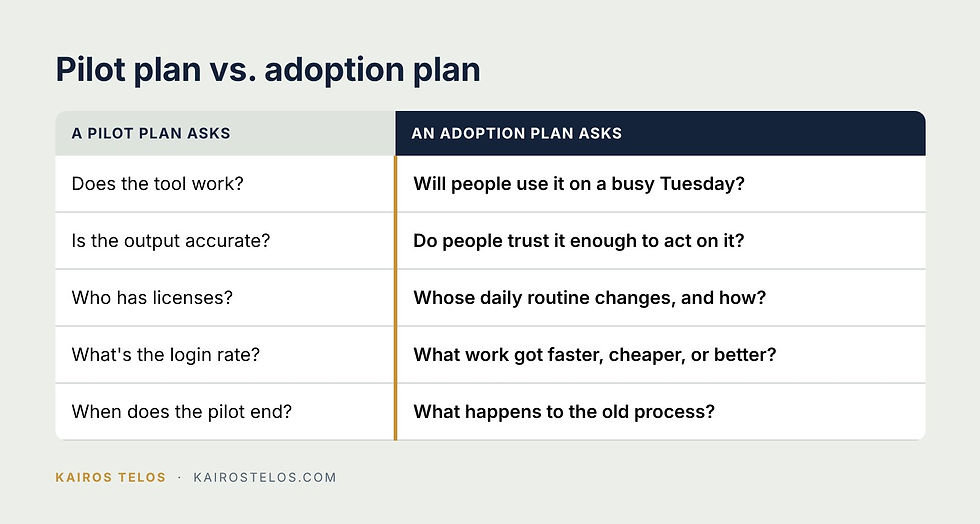
That last row matters most. If the old process still works and nobody turned it off, people drift back to it. Every time.
How long does it take for a new AI habit to stick?
Longer than most pilots run. A well-known study from University College London found that new habits took a median of about 66 days to become automatic, with a huge range depending on the person and the behavior. A 30-day pilot measures curiosity. It doesn't measure adoption.
How do you build an adoption plan in a week?
Pick one workflow, not one tool. "Drafting client follow-up notes after every call" beats "rolling out the new assistant."
Find the trigger. When exactly would someone reach for the tool? After a meeting? Start of day? Put the tool right there.
Make the first win fast. If first use takes twenty minutes of setup, you've lost. Pre-build the templates and prompts.
Have a respected manager use it in public. Seeing a peer rely on it does more than any training session.
Retire something. Name the old step that goes away, and make it go away.
A pilot proves the tool can work. An adoption plan proves your people will use it.
The takeaway
Before your next pilot, write the adoption plan first. If you can't answer the right-hand column, you're not ready to buy licenses. And if you're still deciding which pilot to run at all, the timing questions in The Kairos Question are a good place to start.
Helping leaders make AI stick is a big part of our AI strategy work at Kairos Telos, and it's almost always a people problem before it's a technology problem.
Frequently asked questions
Why do most AI pilots fail?
Most AI pilots measure whether the technology works, not whether people change their routines to use it. Without a plan for triggers, quick wins, social proof, and retiring the old process, usage fades after the novelty wears off.
How long should an AI pilot run?
Long enough to see habits form, not just first impressions. For most workflows that means 60 to 90 days, with weekly check-ins on actual work outcomes rather than login counts.
Who should own AI adoption, IT or the business?
The business leader whose results depend on the workflow. IT owns the platform. The business owns whether the work actually changes.
Running a pilot that's losing steam? Let's figure out why.


Comments