
Founders: Your First Ten Hires Are Your Real Strategy

A few weeks ago I wrote about how founders choose co-founders, and the response told me I'd only covered half the problem. The co-founder decision is huge. The next ten decisions are almost as big, and founders usually make them in a hurry.
Why does early startup hiring strategy matter so much?
Early startup hiring strategy matters because your first ten hires don't just do the work. They set the defaults: how decisions get made, how fast things move, what "good" looks like. Every person you hire after them learns the company from them.
Your pitch deck says what the company will be. Your first ten hires decide it.
Who should you hire at each stage?
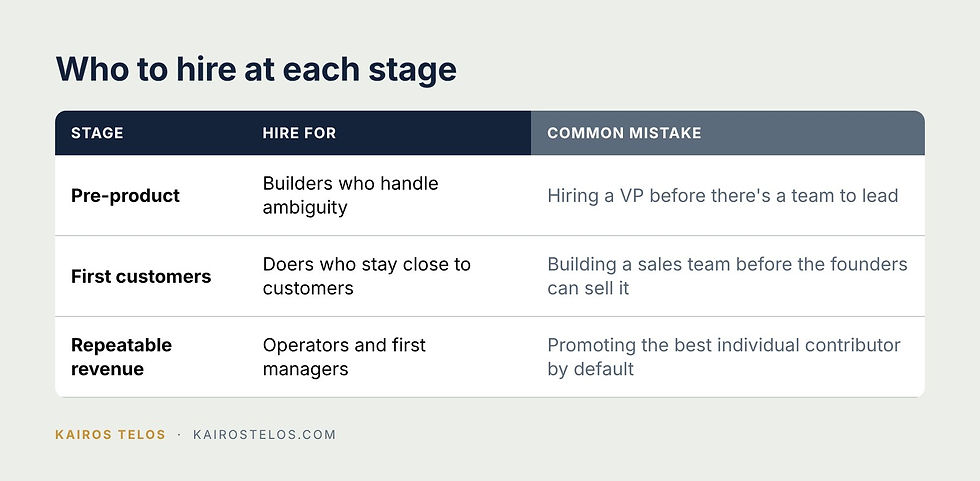
Notice the pattern in the mistakes column. Almost all of them come from hiring for the company you hope to be in two years instead of the company you are today.
Should early hires be generalists or specialists?
Mostly generalists, with one exception. Hire a specialist early only where a mistake would be expensive and hard to undo, like security in a regulated product or core engineering when the technology is the moat. Everywhere else, range beats depth for the first stretch.
What should founders screen for first?
Go back to the three skill buckets from the co-founder post. Flash-Forged skills (product knowledge, tactics) your hires will pick up on the job. Forged Through Fire skills (leadership, technical depth) take time but can be built. Founder's Fiber (resilience, curiosity, bias for action) is what you screen for, because you mostly can't train it.
Your first ten hires don't execute the strategy. They are the strategy.
The takeaway
Before your next hire, write one sentence about which stage you're actually in and what that stage needs. Then hire for that sentence. If you want a second set of eyes on your hiring plan, it's a regular part of the founder advising we do at Kairos Telos.
Frequently asked questions
Who should a startup's first hire be?
Usually someone who closes the biggest gap between the founders and the first paying customers. For technical founders that's often a customer-facing builder. For business founders it's usually engineering.
When should a startup hire its first manager?
When the founders can no longer give every person regular, useful feedback, which typically happens somewhere between 10 and 20 people. Hiring managers before that adds layers without adding speed.
How do you test for resilience in an interview?
Ask for specific stories about setbacks and listen for what the person did next, not how they felt. Reference calls asking how someone handled a bad quarter are often more revealing than the interview itself.
Building your early team? Let's map your next five hires.


Comments